Fertility preservation
Should I think about egg freezing?
What egg freezing involves, how age and AMH affect the discussion, and the questions to ask before deciding.
Egg freezing offers something previous generations of women didn't have: the possibility of preserving eggs at a younger age for potential use later. That can be valuable. But the phrase “freezing your fertility” can give the wrong impression.
Egg freezing preserves eggs. It doesn't guarantee a future baby, and it doesn't stop your reproductive clock.
The ovaries are stimulated with hormone injections so that several follicles develop during the same cycle. The eggs are then collected in a short procedure and mature eggs suitable for freezing are rapidly frozen using a technique called vitrification.
They can remain stored for future use.
If you later decide to use them, the eggs are thawed and those that survive are fertilised with sperm, usually using ICSI, before resulting embryos are considered for transfer.
Not every egg collected will ultimately result in a baby.
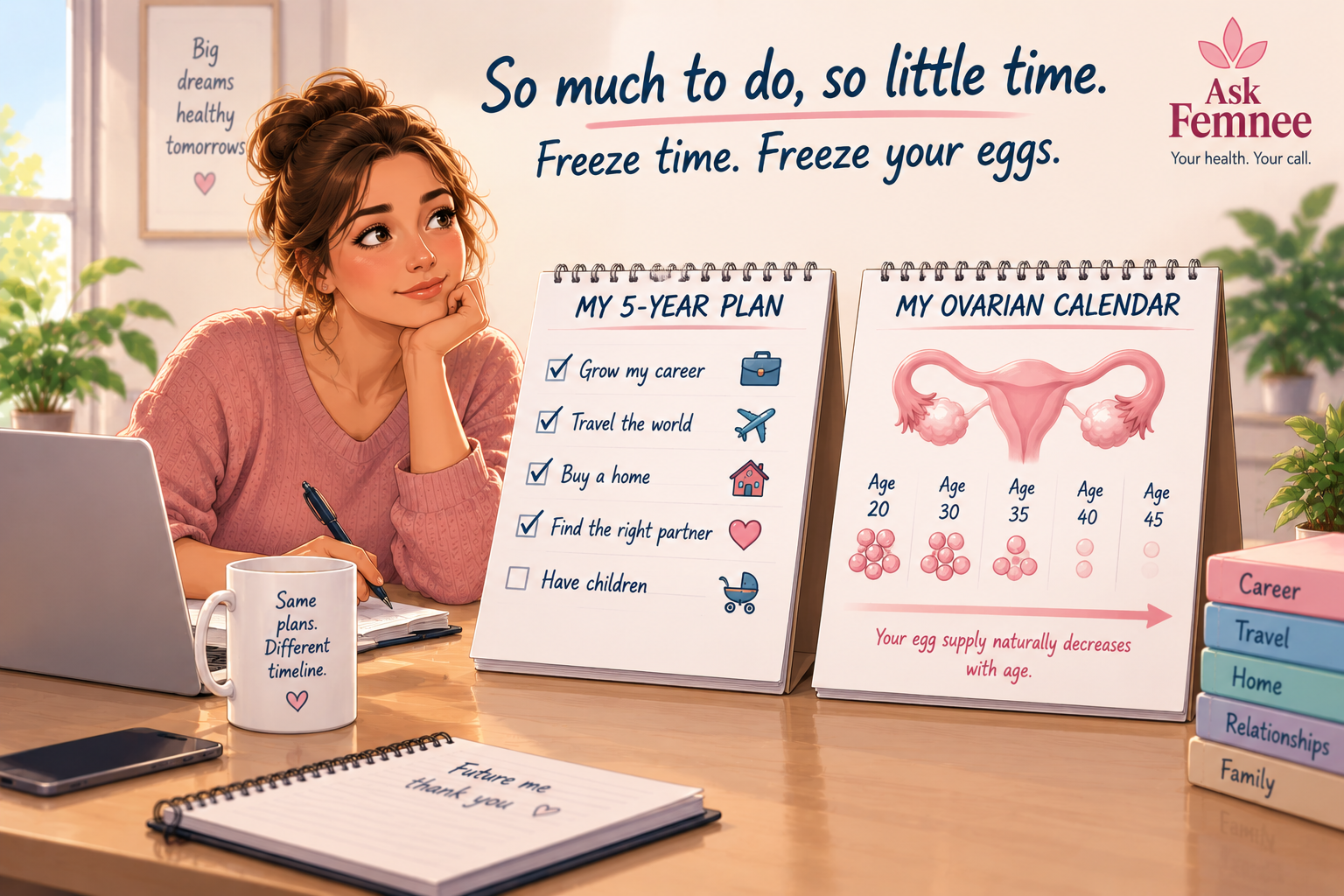
Age at freezing is one of the most important factors affecting the chance that frozen eggs might eventually produce a baby. Younger eggs are more likely to be chromosomally normal. As age increases — particularly through the later 30s — a greater proportion of eggs have chromosomal abnormalities. Freezing them doesn't reverse that.
In other words:
Eggs remain biologically the age you were when they were frozen.
Some women consider it because they want children but aren't currently in a position to try — perhaps because of relationships, career, education or other circumstances. Others may face medical treatment that could affect ovarian function. Some have a family history or medical condition that raises concerns about their reproductive lifespan. And some simply want to understand whether egg freezing is a sensible option for them. The decision is personal. The important thing is to understand what it may offer and what it cannot promise.
AMH gives us information about ovarian reserve and can help estimate how the ovaries may respond to stimulation. That can be useful when considering egg freezing.
But AMH doesn't measure egg quality.
A 30-year-old with lower AMH and a 39-year-old with higher AMH present very different situations because the age of the eggs matters greatly. The decision should therefore not be reduced to an AMH number.
There is no number of frozen eggs that guarantees a baby. Some eggs will not be mature. Some may not survive thawing. Some will not fertilise. Some embryos will stop developing, and some transferred embryos will not result in a live birth. Age at freezing makes a substantial difference to those probabilities. This is why the sensible discussion is not simply “Can you freeze some eggs?” It is:
“At my age, what might a realistic number of frozen eggs give me a reasonable chance of achieving?”
Sometimes more than one stimulation cycle may be considered to accumulate enough eggs.
You may never need to use your frozen eggs. Many women who freeze eggs later conceive naturally. But having eggs stored should not be interpreted as a guarantee that pregnancy can safely be postponed indefinitely. Pregnancy itself also changes with maternal age, independently of the age of a frozen egg.
Before committing to treatment, useful questions include:
- What is my ovarian reserve?
- How does my age affect the likely outcome?
- Roughly how many eggs might I obtain in one cycle?
- Might I realistically need more than one cycle?
- What proportion of frozen eggs survive thawing?
- How would the eggs eventually be fertilised?
- What are the treatment and ongoing storage costs?
- What happens if I never use them?
A clinic should be able to discuss these without making egg freezing sound either pointless or guaranteed.
Sources and further reading
- HFEA information on egg freezing and fertility preservation
- NICE fertility guidance
- NHS fertility information
Medical review
Medically reviewed by Dr Mahadeo Bhide, MD, MRCOG
Last medically reviewed: September 2026